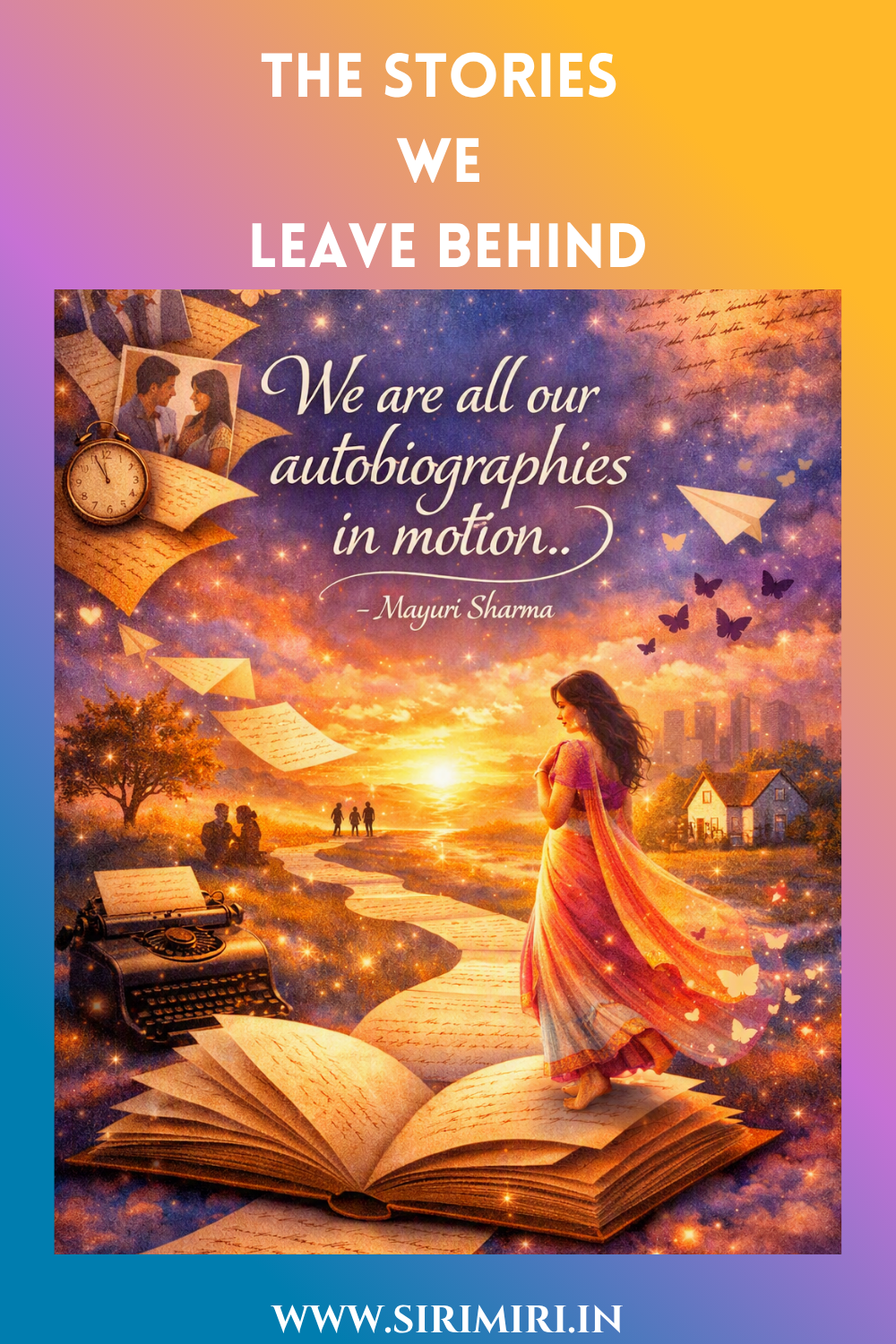
“We are all our autobiographies in motion.” — Mayuri Sharma
Decades ago, a life-changing event made me think of this, and I coined this line. The more I think about it, the more I realise how much it says about the way we live.
Because every day, we write ourselves into other people’s memories.
Some people will get to read only a page of you. Some will get a paragraph. Some may be part of a chapter.
And then there are the very few who get to read the whole book.
The beginning. The middle. The messy bits. The plot twists. The chapters you don’t particularly want anyone to see.
They know the contradictions. The mistakes. The growth. The things you survived. The person you were, and the person you became.
But here’s the thing about an autobiography:
You don’t get to decide which pages other people will remember.
Someone may remember you for one conversation. Someone else may remember something you did ten years ago. Someone may remember the way you made them laugh. Someone may remember the way you hurt them. Someone may remember a kindness you have completely forgotten. And someone may carry a sentence you said casually for the rest of their life.
That is the strange, beautiful and sometimes uncomfortable thing about human relationships.
We leave pieces of ourselves behind in other people.
Our words. Our actions. Our silences. Our generosity. Our cruelty. Our courage. Our apologies, or the absence of them. The way we showed up when someone needed us. The way we behaved when we had nothing to gain. The way we made people feel when they were around us.
These become part of our legacy.
And legacy isn’t necessarily about fame, wealth, achievements or the things our names might be attached to.
Sometimes, our greatest legacy is much quieter.
It is the person who became braver because you believed in them. The friend who still laughs when they remember something ridiculous you did together. The child who remembers that you listened. The stranger who remembers an unexpected kindness. Or, sometimes, the person who remembers being hurt by you and carries that experience forward.
We don’t get to choose all of it.
We are constantly writing, even when we don’t realise we’re holding the pen.
A sentence here. An action there. A memory. A wound. A laugh. A lesson. A moment of kindness. A moment of selfishness. Page by page, interaction by interaction, we are creating the story we will eventually leave behind.
And perhaps that is the most humbling thing about being human: We are not only living our lives. We are becoming stories in other people’s lives.
Some of us will be a footnote. Some, a paragraph. Some, a chapter.
And if we are very fortunate, a few people will read the whole book and still turn the pages with tenderness.
So, write carefully. Not perfectly. Consciously.
Because long after we are gone, our words and our actions may be the only parts of us that remain.
And maybe that is what a meaningful life really is: Not simply the life we lived, but the stories we leave behind.
