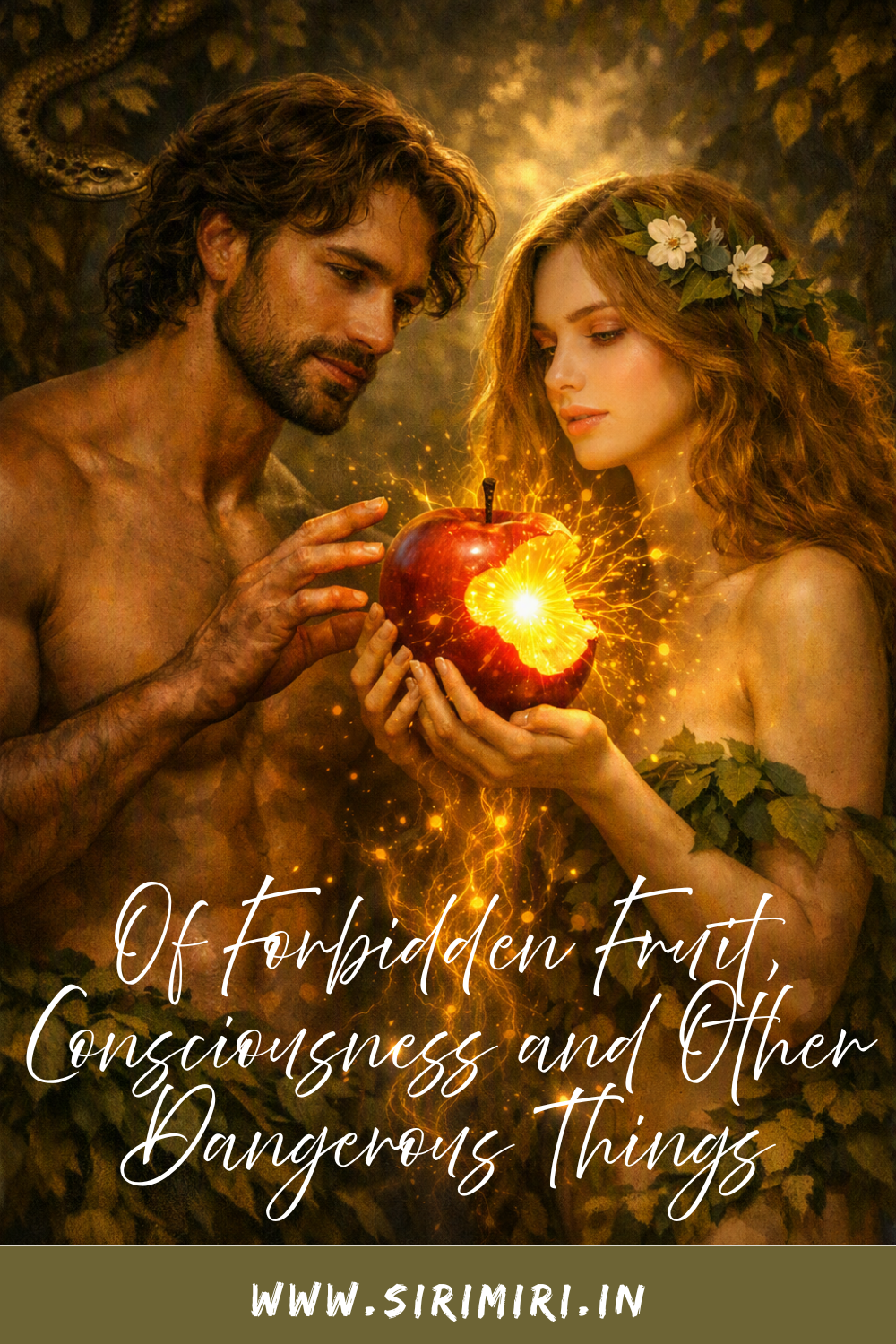
I came across this sentence recently: “The forbidden fruit was a state of consciousness.”
And suddenly, the story of the Garden of Eden looked very different to me.
What if the fruit was never really about the fruit? What if it was about knowing?
Before the fruit, there is innocence.
After they bite into it, Adam and Eve suddenly see. They notice their nakedness. They feel shame. They hide. They become aware of themselves.
And that is where the story gets interesting.
Because consciousness does something rather inconvenient. It makes us aware.
Aware of ourselves. Aware of others. Aware of what we want. Aware of what we fear. Aware of our choices and their consequences.
And once you know something, you cannot comfortably return to not knowing it.
That may have been the real bite of the fruit. Awareness.
Then there is another word worth examining: Forbidden. Forbidden doesn’t necessarily mean wrong. It means prohibited.
Someone has drawn a boundary and decided you should not cross it. And throughout history, “forbidden” has been a remarkably effective way of controlling minds.
Don’t ask. Don’t question. Don’t doubt. Don’t challenge. Don’t look too closely. Don’t think too much. Don’t step outside the role assigned to you. Because if you can convince someone that certain questions are dangerous, you don’t have to answer them. You only have to make them afraid to ask.
But consciousness makes us curious.
It makes us ask: Why? Why must this be so? Who decided? Who benefits? What if I disagree? What if what I’ve been taught isn’t the whole truth? And that little question can cause a surprising amount of trouble.
Because sometimes we discover that what we thought were immutable truths were simply beliefs repeated so often that they began to feel like facts.
We inherit ideas about what makes a good woman. A good man. A good daughter. A successful person. A respectable life.
We absorb rules from family, culture, religion and society, often without ever consciously choosing them.
Until one day we stop and ask: “Do I actually believe this?” That is consciousness at work.
And consciousness gives us something else: choice.
We can think differently. Live differently. Choose differently. We can question the script. Change our minds. Interrupt patterns that have travelled through generations. Decide that an inherited belief no longer belongs in our lives.
Sometimes the most dangerous thing consciousness does is give us permission to choose. And isn’t that what happens in our own lives?
We recognise a pattern we’ve been repeating. We understand that a boundary we’ve been calling “selfish” is actually self-respect. We discover that the life we’ve been tolerating isn’t the life we want. We realise that being needed isn’t the same as being loved. We see ourselves differently. And suddenly, we cannot unknow.
The old version of us may still be standing there, looking longingly at the garden. But she can’t go back. Because she knows.
Sometimes the forbidden fruit is discovering your own worth.
You spend years believing your value comes from being useful, accommodating, successful, desirable, needed. And then consciousness bites. You realise: I am not valuable because of what I provide. I provide because I am valuable.
That’s a profound shift.
Because once you know your worth, you may stop auditioning for love. You may stop shrinking yourself to fit somebody else’s expectations. You may disappoint people. You may say no. You may choose yourself. And a person who knows their worth becomes considerably harder to control.
Maybe that’s why awakening can be uncomfortable. It doesn’t necessarily make life easier. It makes life more honest. You start seeing the cage. And once you can see the cage, it becomes rather difficult to convince yourself that it is a home.
Maybe the forbidden fruit was never forbidden because knowledge was bad. Maybe it was forbidden because knowledge changes you.
It gives you responsibility. It gives you choice. It gives you the ability to think. To question. To choose differently.
And sometimes, the freedom to say: “No. I don’t want this anymore.”
A profound difference exists between obedience and consciousness. One says: “Tell me what to think.” The other says: “Let me think.”
And maybe freedom begins there.
Maybe consciousness is the fruit. Maybe awakening is the bite. Maybe thinking is the first act of rebellion. And choosing differently is the second.
So, the question isn’t simply: “Why did they eat the forbidden fruit?” Maybe it is: “Who taught us to be afraid of becoming conscious?”
And now I can’t stop thinking about it. Which is rather inconvenient, as I had perfectly good plans for today. But then again…that’s what happens when you bite into forbidden fruit. You start thinking.
And once you start thinking for yourself, you may discover that the most dangerous thing you can become isn’t rebellious.
It’s awake.
