Apparently, I am an Intellectual Omnivore.
I saw the term recently, googled it to learn more, watched a few reels about it, and immediately thought: Well. That explains a lot.
An intellectual omnivore is someone whose curiosity isn’t particularly interested in staying in its lane. They consume ideas, information and perspectives from a wide range of subjects rather than restricting themselves to one field or intellectual discipline.
Psychology? Yes.
History? Absolutely.
Feminism? Tell me more.
Mythology, philosophy, spirituality, human behaviour, relationships, politics, literature, language, science, art, fashion, culture?
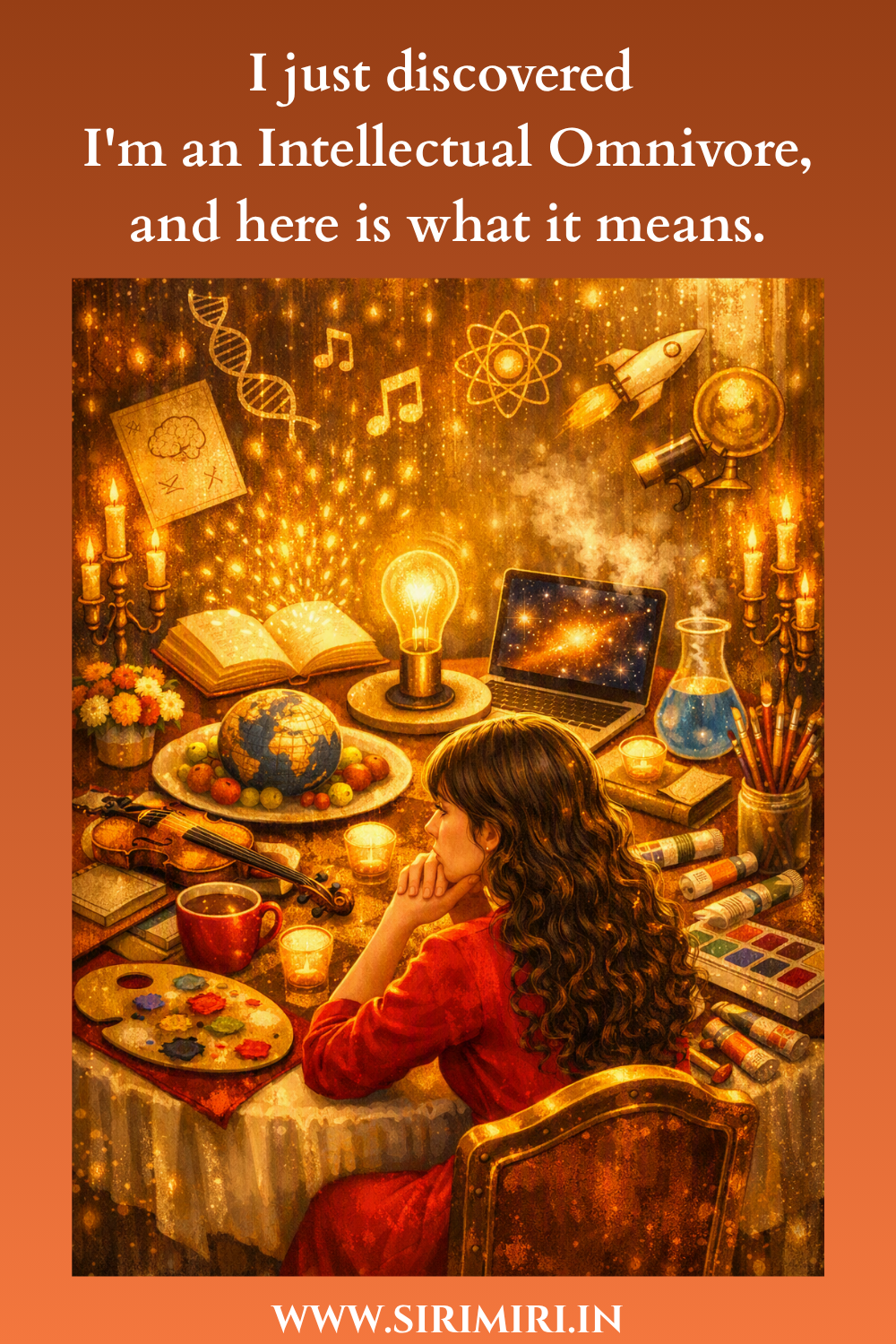
My brain: Yes, please. Put it all on the plate.
And no, I don’t necessarily want to become an expert in everything I encounter. I want to understand things. I want to know why people behave the way they do.
Why societies become the way they are. Why we believe what we believe. Why one person experiences something as liberation while another experiences the same thing as chaos. Why a particular word feels better than another? Why a story works. Why an idea catches fire. Why people make choices that appear completely irrational until you understand what is happening underneath them.
And occasionally, why I am emotionally invested in a pair of red stilettos.
I think intellectual omnivores share something else.
We are comfortable saying: “I don’t know.” Because “I don’t know” is not an intellectual failure. It is an invitation. It leaves the door open.
I love learning from people who know more than I do. I love changing my mind when I encounter better information. I love asking questions. And I have very little interest in pretending to know something simply because everyone else seems to know it.
Curiosity, for me, isn’t an activity. It’s how I move through the world.
I am perpetually wondering. Why? How? What if? Is there another way of looking at this? And sometimes: Wait. What does THAT mean?
I also think this is why people feel comfortable around me.
Whether as a friend, a colleague, a client, a professional acquaintance, or simply someone sitting across a table having a conversation, I am genuinely interested in people. I don’t need everyone to think like me. I don’t even need them to agree with me. I want to know how they arrived at their thinking.
That distinction matters.
When you are curious about people rather than busy categorising them, conversations become easier. People can tell when they are being listened to, not assessed.
And perhaps that is one of the unexpected gifts of being an intellectual omnivore:
You learn to make room.
For different experiences. Different perspectives. Different ways of seeing the world. Different kinds of intelligence. And different kinds of people.
Being an Intellectual Omnivore is also ridiculously useful for a writer.
Writing is, after all, about people. And people are complicated creatures. A writer who only looks at the world through one lens can tell one kind of story.
But give me psychology, history, mythology, relationships, sociology, humour, language, culture, observation and a little bit of human ridiculousness…Now we’re cooking!
Psychology can change the way I write a character.
History can change the way I understand a conflict.
Literature can teach me about structure and voice.
Human behaviour can give me the tiny detail that makes a character believable.
Philosophy can change the question at the heart of a story.
And curiosity makes me look twice.
At a conversation. A gesture. A contradiction. A silence. A person who says one thing and does another. A seemingly insignificant moment that might actually be the beginning of something much bigger.
That’s where stories live. In the connections.
Perhaps that’s the real advantage of an intellectual omnivore. We don’t just collect information. We cross-pollinate ideas.
We take something from here, something from there, turn it around, examine it from another angle and sometimes end up seeing something that wasn’t visible when all the pieces were kept in separate boxes. I don’t think curiosity needs a destination. Sometimes it just needs an appetite.
So yes. I may be an Intellectual Omnivore.
My brain doesn’t have a niche. It has a buffet. And apparently, I intend to sample everything.
Pass the plate.

1 thought on “I just discovered I’m an Intellectual Omnivore, and here is what it means.”